Before Christmas, I had a wide ranging conversation of nearly 90 minutes with David Speers, General Director of Opera Hamilton. He's a passionate advocate for opera, and the arts in general, in our community. I distilled that encounter into a piece tailored to the readership of the Greater Hamilton Musician.
Editor Glen Brown further reduced the word count to make it fit in the print Annual Edition.
Here's a link to the on-line version.
On-line Greater Hamilton Musician Annual Edition
Sunday, January 20, 2013

Tuesday, January 8, 2013
Peter Jackson et al vs. J.R.R. Tolkien
I have a rather peculiar, if not unique, view of J.R.R. Tolkien's children's book The Hobbit. I read it aloud about a dozen times to children in my language class in the course of the career which I pursued parallel to my professional musical one.
I'd first made my way through The Lord of the Rings as a teenager and it's about the only Fantasy writing I've ever read.
I encountered The Hobbit when I first read it aloud."Read-Alouds" are an intrinsic part of a balanced reading program and teachers frequently read favourite titles that are too hard for most of their audience to read themselves. I know teachers who read Children's Literature for pleasure and must admit that I could never stomach it. I tried to read two of the Harry Potter series myself and didn't like them much.
The Hobbit is pretty slow going as a read-aloud. I had class set of the novel and offered a copy to children, usually better readers, who wanted to read along. It went over much better with boys than girls. A couple of times I just gave up with groups that hadn't the collective attention span to make sense of the long passages of description.
In any event, I went this afternoon to see the most recent Peter Jackson movie (3D IMAX), one of the perks of not having to work in the daytime. The theatre was surprisingly full of quiet, mostly older, people. No children.
This is an epic story, as is The Lord of the Rings which Tolkien wrote later. Lots of it is "over the top", but that's what's called for in any epic. Jackson and his team don't follow the book very closely at all. I'm quite sure that this would have bothered me more if I'd read The Hobbit more recently. As it was, I enjoyed it immensely although I'm not going to see it a second time any time soon.
I had read Ken Follet's The Pillars of the Earth and, not long after, I saw the TV mini-series. I was horrified. It seemed to be all hyperbole, the subtlety of the story completely written out. I watched it again recently on Blue-ray. No ads, no stopping and several years from the reading. I had a completely different impression. It was an impressive piece of story telling.
There's no doubt that adapting art from one medium to another is an incredibly challenging process and there's no winning. Artistic decisions must be made in virtually every frame: change the story, re-order it, cast actors who bear little (or no) resemblance to the characters in the original version, cram the dozen or more climaxes of a book which might take a week to read into a two hour film.
Someone, somewhere, will object to every one.
These are the decisions adaptors have to make in the course of producing an artistically and commercially viable product.
I watched Avatar again recently and the effects, CGI and otherwise, are jaw dropping. The same can be said of The Hobbit: An Unexpected Journey, indeed of many current movies. It's all part of the repertoire of film makers these days and audiences expect to see it.
The difference, of course, is that these are brilliant films by experienced, dedicated film makers. The same technology is available to anyone, experienced, dedicated or otherwise, with the money to use it. Many crappy though technologically sophisticated movies have been, and will be made, and will disappear into the world of DVD and on-demand release.
In closing I'll mention Howard Shore's score. It must be a good one because, aside from the recurring quiet Celtic-inspired melody which I recall from the LOTR films, I don't remember any of it. You're not supposed to notice film music. Too bad for the composers, I guess.
I'd first made my way through The Lord of the Rings as a teenager and it's about the only Fantasy writing I've ever read.
 |
| Galadriel (Cate Blanchett) and Gandalf (Ian McKellen) |
I encountered The Hobbit when I first read it aloud."Read-Alouds" are an intrinsic part of a balanced reading program and teachers frequently read favourite titles that are too hard for most of their audience to read themselves. I know teachers who read Children's Literature for pleasure and must admit that I could never stomach it. I tried to read two of the Harry Potter series myself and didn't like them much.
The Hobbit is pretty slow going as a read-aloud. I had class set of the novel and offered a copy to children, usually better readers, who wanted to read along. It went over much better with boys than girls. A couple of times I just gave up with groups that hadn't the collective attention span to make sense of the long passages of description.
In any event, I went this afternoon to see the most recent Peter Jackson movie (3D IMAX), one of the perks of not having to work in the daytime. The theatre was surprisingly full of quiet, mostly older, people. No children.
This is an epic story, as is The Lord of the Rings which Tolkien wrote later. Lots of it is "over the top", but that's what's called for in any epic. Jackson and his team don't follow the book very closely at all. I'm quite sure that this would have bothered me more if I'd read The Hobbit more recently. As it was, I enjoyed it immensely although I'm not going to see it a second time any time soon.
I had read Ken Follet's The Pillars of the Earth and, not long after, I saw the TV mini-series. I was horrified. It seemed to be all hyperbole, the subtlety of the story completely written out. I watched it again recently on Blue-ray. No ads, no stopping and several years from the reading. I had a completely different impression. It was an impressive piece of story telling.
 |
| Matthew McFadyen from Pillars of the Earth |
There's no doubt that adapting art from one medium to another is an incredibly challenging process and there's no winning. Artistic decisions must be made in virtually every frame: change the story, re-order it, cast actors who bear little (or no) resemblance to the characters in the original version, cram the dozen or more climaxes of a book which might take a week to read into a two hour film.
Someone, somewhere, will object to every one.
These are the decisions adaptors have to make in the course of producing an artistically and commercially viable product.
I watched Avatar again recently and the effects, CGI and otherwise, are jaw dropping. The same can be said of The Hobbit: An Unexpected Journey, indeed of many current movies. It's all part of the repertoire of film makers these days and audiences expect to see it.
 |
| From James Cameron's Avatar |
The difference, of course, is that these are brilliant films by experienced, dedicated film makers. The same technology is available to anyone, experienced, dedicated or otherwise, with the money to use it. Many crappy though technologically sophisticated movies have been, and will be made, and will disappear into the world of DVD and on-demand release.
In closing I'll mention Howard Shore's score. It must be a good one because, aside from the recurring quiet Celtic-inspired melody which I recall from the LOTR films, I don't remember any of it. You're not supposed to notice film music. Too bad for the composers, I guess.
 |
| Howard Shore |
Sunday, December 16, 2012
Ensemble Lyrica @ Central Presbyterian
There's enough quality choral music for Christmas that you could program a different concert for a hundred years without repeating any. Solo music is a different matter. There's hardly any. I've written Five Christmas Ceremonies for high voice and piano. The poems are by Robert Herrick and three are religious, the other two secular. Any soprano, tenor or accompanist interested in seeing the songs can contact me. By Christmas next year the songs will be available from the Canadian Music Centre.
In any event, you know the choral season is busy when a choir presents a concert of carols and Christmas Music at 3:00 P.M. on a Saturday afternoon!
That's why I was at Central Presbyterian Church in Hamilton yesterday hearing Ensemble Lyrica, a 24-voice choir conducted by Brent Fifield, the organist at Trinity Anglican Church in Cambridge. They were accompanied in some numbers by Central Presbyterian organist Paul Grimwood.
This is a group of 27 enthusiastic amateur choral singers (including John Laing, who no longer conducts the eponymous singers) and a couple of others whose names I recognized. The choir was founded only in 2011 and gets by on bi-weekly rehearsals. I suspect that all of the participants sing, at least, in a church choir and some of them in another choir as well.
The choir was very well prepared by Fifield. The words were frequently intelligible in English, French and German (this is a rather live acoustic space, ideal for the big 80 rank Casavant organ).
As is often the case with small choirs of amateur singers, individual voices sometimes stuck out. There was occasionally some shoutiness from the basses. The sopranos make unnecessary crescendos on many of the higher notes in the manner of some trebles.
A half dozen of the choristers took turns as soloists giving some insight into the overall sound of the choir. There's a least one real young tenor (Matthew Bowman) and a good baritone (Peter Dooley, also probably a tenor) who matched soprano Stephanie Fifield note for note.
They sang 15 seasonal pieces in two short halves punctuated by an overly long interval.
Among the highlights, I heard, for the first time, Johann Eccard's Über Gebirg Maria geht, a lovely high Renaissance carol. Choir conductors who don't know this one should look it up.
There were two Vaughn-Williams pieces. Wither's Rocking Hymn and the Fantasia on Christmas Carols with Roland Fix as soloist.
They sang Michael Praetorius' two choir In Dulci Jubilo which was followed by Grimwood's rendition of Denis Bédard's showy organ variations on the same theme.
The choir performed Howells' Here is the Little Door. It's a pretty little piece, unlike the big, effusive Howells works with which I am more familiar.
I must mention Bob Chilcott's The Time of Snow. It's a lovely, quiet work. With Paul Grimwood at the piano for the only time, playing the vaguely Japanese sounding accompaniment, it made an effective contrast to all the other music. This is another work conductors should look for.
They finished with Imogen Holst's familiar arrangement of Here We Come a Wassailing.
All in all, I'll return in the spring to hear their next concert and other choral afficionados from this region should too. This is a good little choir. They are well prepared and sing interesting repertoire. This recital was free with a good will offering. What else do you want?
In any event, you know the choral season is busy when a choir presents a concert of carols and Christmas Music at 3:00 P.M. on a Saturday afternoon!
That's why I was at Central Presbyterian Church in Hamilton yesterday hearing Ensemble Lyrica, a 24-voice choir conducted by Brent Fifield, the organist at Trinity Anglican Church in Cambridge. They were accompanied in some numbers by Central Presbyterian organist Paul Grimwood.
 |
| Brent Fifield |
This is a group of 27 enthusiastic amateur choral singers (including John Laing, who no longer conducts the eponymous singers) and a couple of others whose names I recognized. The choir was founded only in 2011 and gets by on bi-weekly rehearsals. I suspect that all of the participants sing, at least, in a church choir and some of them in another choir as well.
The choir was very well prepared by Fifield. The words were frequently intelligible in English, French and German (this is a rather live acoustic space, ideal for the big 80 rank Casavant organ).
As is often the case with small choirs of amateur singers, individual voices sometimes stuck out. There was occasionally some shoutiness from the basses. The sopranos make unnecessary crescendos on many of the higher notes in the manner of some trebles.
A half dozen of the choristers took turns as soloists giving some insight into the overall sound of the choir. There's a least one real young tenor (Matthew Bowman) and a good baritone (Peter Dooley, also probably a tenor) who matched soprano Stephanie Fifield note for note.
They sang 15 seasonal pieces in two short halves punctuated by an overly long interval.
Among the highlights, I heard, for the first time, Johann Eccard's Über Gebirg Maria geht, a lovely high Renaissance carol. Choir conductors who don't know this one should look it up.
There were two Vaughn-Williams pieces. Wither's Rocking Hymn and the Fantasia on Christmas Carols with Roland Fix as soloist.
They sang Michael Praetorius' two choir In Dulci Jubilo which was followed by Grimwood's rendition of Denis Bédard's showy organ variations on the same theme.
The choir performed Howells' Here is the Little Door. It's a pretty little piece, unlike the big, effusive Howells works with which I am more familiar.
I must mention Bob Chilcott's The Time of Snow. It's a lovely, quiet work. With Paul Grimwood at the piano for the only time, playing the vaguely Japanese sounding accompaniment, it made an effective contrast to all the other music. This is another work conductors should look for.
They finished with Imogen Holst's familiar arrangement of Here We Come a Wassailing.
All in all, I'll return in the spring to hear their next concert and other choral afficionados from this region should too. This is a good little choir. They are well prepared and sing interesting repertoire. This recital was free with a good will offering. What else do you want?
Monday, October 29, 2012
Requiem for Peace with Orpheus Choir
I made the trek down the QEW to Metropolitan United Church in Toronto on Saturday night to hear a performance of Canadian Larry Nickel's doctoral work, The Requiem for Peace. I'd been impressed by some of the work to which I had listened on line and was interested in hearing the piece live for both aesthetic and professional reasons.

The performance was being conducted by Robert Cooper with whom I sang, as an undergraduate, in the Faculty of Music Singers (now UWO Singers) at what was then The University of Western Ontario (now Western University of Canada) under Deral Johnson.
The performers included the Orpheus Choir of Toronto, the MacMillan Singers from the University of Toronto (prepared by their conductor Hilary Apfelstad) and a seven player chamber ensemble consisting of flute, clarinet, oboe, harp, piano and two percussionists.
Solos were taken by the mezzo-soprano Michelle Sun and the eight Sidgwick Scholars, young singers who are the Orpheus Choir's leads.
The Requiem for Peace is in fifteen choral movements and two instrumental ones which introduce the first and second parts. The movements are in various languages (Latin, English, Hebrew, French, Russian, Dutch, German, Chinese, Japanese) and the texts are from the Latin Mass and assorted poets including Victor Hugo and Wilfred Owen to whose poetry Britten also set his War Requiem.
The Requiem for Peace was conceived for a large choir and orchestra. The pictures of the première look like a performance of Mahler's Eighth. Dr. Nickel created this reduced orchestra version of the work which was first performed by the Vancouver Chamber Choir of which he is a member.

The idiom is highly accessible. It's likely that only a few of the audience had listened to any part of this piece before, but it was very well received. Larry Nickel is an accomplished choral composer with scores of published pieces and dozens of recordings to his credit. This work, his longest and most elaborate, is a remarkable achievement.
The instrumentalists, all working professionals, played well and the choral preparation was first rate. English texts were not published in the program but, most of the words were comprehensible, something which is often not the case in choral singing. Robert Cooper is to be congratulated.
Most of the soloists were merely adequate. It's not that they didn't sing accurately or that they had poor voices or technique, rather that this is a weighty work and, with a large choir, they simply hadn't sufficient presence. Baritone Tristan Jones and mezzo-soprano Jocelyn Fralick stood out among them. I'd like to hear this work again with older, more accomplished singers.
The performance was accompanied by projected images, compiled by Joan Nicks, an adjunct professor at Brock University. The pictures were chosen to fit the texts and enriched, rather than distracted from, the musical experience.
She also put together images to go with a fifteen minute segment of the CBC radio show Tapestry about the Requiem for Peace which was played before the performance.

Composer Larry Nickel
The performance was being conducted by Robert Cooper with whom I sang, as an undergraduate, in the Faculty of Music Singers (now UWO Singers) at what was then The University of Western Ontario (now Western University of Canada) under Deral Johnson.
The performers included the Orpheus Choir of Toronto, the MacMillan Singers from the University of Toronto (prepared by their conductor Hilary Apfelstad) and a seven player chamber ensemble consisting of flute, clarinet, oboe, harp, piano and two percussionists.
Solos were taken by the mezzo-soprano Michelle Sun and the eight Sidgwick Scholars, young singers who are the Orpheus Choir's leads.
The Requiem for Peace is in fifteen choral movements and two instrumental ones which introduce the first and second parts. The movements are in various languages (Latin, English, Hebrew, French, Russian, Dutch, German, Chinese, Japanese) and the texts are from the Latin Mass and assorted poets including Victor Hugo and Wilfred Owen to whose poetry Britten also set his War Requiem.
The Requiem for Peace was conceived for a large choir and orchestra. The pictures of the première look like a performance of Mahler's Eighth. Dr. Nickel created this reduced orchestra version of the work which was first performed by the Vancouver Chamber Choir of which he is a member.
Vancouver première for large choir and orchestra
The idiom is highly accessible. It's likely that only a few of the audience had listened to any part of this piece before, but it was very well received. Larry Nickel is an accomplished choral composer with scores of published pieces and dozens of recordings to his credit. This work, his longest and most elaborate, is a remarkable achievement.
The instrumentalists, all working professionals, played well and the choral preparation was first rate. English texts were not published in the program but, most of the words were comprehensible, something which is often not the case in choral singing. Robert Cooper is to be congratulated.
Most of the soloists were merely adequate. It's not that they didn't sing accurately or that they had poor voices or technique, rather that this is a weighty work and, with a large choir, they simply hadn't sufficient presence. Baritone Tristan Jones and mezzo-soprano Jocelyn Fralick stood out among them. I'd like to hear this work again with older, more accomplished singers.
The performance was accompanied by projected images, compiled by Joan Nicks, an adjunct professor at Brock University. The pictures were chosen to fit the texts and enriched, rather than distracted from, the musical experience.
She also put together images to go with a fifteen minute segment of the CBC radio show Tapestry about the Requiem for Peace which was played before the performance.
Thursday, October 25, 2012
Rigoletto at Theatre Aquarius
We attended the Tuesday October 23rd performance of Opera Hamilton's Rigoletto at Hamilton's Theatre Aquarius sitting in the third row of the balcony.
This hall is an intimate space for opera (at about 750 seats) but, since it was designed for spoken theatre, the acoustics are not really live enough for unamplified music performances.
The sound and sight lines from the balcony are every bit as good as the seats in the orchestra and, certainly, preferable to sitting in the first few rows.

In this production the story is updated to the 21st Century and presented on a skeletal, but not minimalist, set. I'm usually partial to traditional productions but, at the end of the day, this approach worked for me and Director and Designer Michael Cavanagh is to be congratulated for a fresh look for this standard repertoire opera.
The opening scene is a corporate Hallowe'en party and the entire cast is costumed with the Duke and Rigoletto in the 16th Century garb one would expect in a period production, helping the audience to make the bridge from Victor Hugo to the present.

The second scene, however, is in Rigoletto's apartment where Gilda, in shorts and a fleece top is, presumably, surfing the Internet on her Macbook.
The four main players are all very good. Jason Howard, who has sung Rigoletto before, was dramatically convincing. He sang much of the role loudly which, while unavoidable in the Wagnerian repertoire which has been has recent work, is not desirable in some of this role or in a house this size. I've noticed this tendency of baritones in this house before (Hugh Russell and Alexandre Sylvestre did it last season in Il Barbiere). I know from personal experience that this is a difficult hall in which to sing since it sends nothing back to the singer. Nonetheless, singers should get out into the hall and listen to the others during the rehearsals to better understand the acoustics.
Tenor Gordon Gietz was an effective and credible Duke. He was sometimes out of tune in the upper middle of his voice but sported impressive and dependable top notes, including a lovely piano high B at the ending the reprise of La Donna e Mobile.
Lauren Segal did a expert job with the role of Maddalena. The character appears only in the final act but, with both her singing and acting, she persuasively portrayed this experienced woman who has been instantly captivated by the Duke. Her rich mezzo provided a favourable contrast to the other principal singers in the cast.
Finally, soprano Simone Osborne was surely the star of the show. She sang the coluratura role of Gilda simply and accurately. Her Caro Nome was stunning. Osborne's portrayal of the character was also convincing. There is little else to say. Watch for her when she comes to an opera house near you.

Bass Taras Kulish played both Monterone and the assassin Sparafucile. He's a good actor and contributed a ringing low F at the end of his duet with Rigoletto. Sadly his high notes tend to be pushed.
Chorus Master Peter Oleskevich must has taken the chorus to the woodshed after the not very complimentary review was published in the Hamilton Spectator Monday. Certainly, their singing was much improved over last year's Trovatore. The chorus was reinforced by the male comprimario leads.
All of the smaller role were well dealt with by Ben Covey (Marullo), Jason Hales (Matteo Borsa), Michael Rusnak (Count Ceprano), Iasmina Pataca (Giovanna), Countess Ceprano (Breanna Temple), Stephen Berryman (An Usher) and Rachel Weisdorf (A Page).
The orchestra, all first rate players from the Philharmonic played pretty well under conductor and General Director David Speers. With only 30 musicians, I do miss the full Verdi orchestration. This is one of the few halls in which the singers on stage don't need to "put out" to be heard over the orchestra, rather, it's the other way around.
The Popera Plus concert in January features John Fanning. Four performances of Les Pêcheur de Perles are coming up in early March with Brett Polegato and Virginia Hatfield. Other cast members have yet to be announced.
Sunday, October 21, 2012
On Mindset
I watched The Searchers (1956) the other afternoon. I'd recorded it (from WNED in HD) earlier after checking with Rotten Tomatoes, my go-to source of movie info.
If you've never encounter it, Rotten Tomatoes offers percent approval ratings (two of them actually, one from their list of critics and another from their "members") on most movies you might consider seeing on TV, computer services or currently in the theatres. It's not foolproof, but is more dependable than one critic or your Uncle Bob.
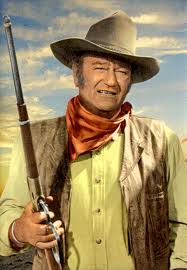
Anyway, The Searchers is a John Ford Western starring John Wayne. Ford directed many Westerns, 14 movies with John Wayne and this one is considered his best. Rotten Tomatoes rated it 98%/86%. That's quite an endorsement.
Overall, I enjoyed the movie although some of it was cringeworthy. There's a romantic subplot that provides the comic relief, the scenes of which seem at odds with the rest of the film. The John Wayne character is an out-and-out racist but there is none of the contextualizing you would find in a contemporary film. Finally, it is a Cowboys-and-Indians Western. There are all sorts of conventions inherent to this genre. As a child I learned them watching TV series like Gunsmoke and Bonanza. Even though I had all the tools, the mindset, to understand this film, 56 years on, I wasn't as engaged as I expected to be.


If you've never encounter it, Rotten Tomatoes offers percent approval ratings (two of them actually, one from their list of critics and another from their "members") on most movies you might consider seeing on TV, computer services or currently in the theatres. It's not foolproof, but is more dependable than one critic or your Uncle Bob.
Anyway, The Searchers is a John Ford Western starring John Wayne. Ford directed many Westerns, 14 movies with John Wayne and this one is considered his best. Rotten Tomatoes rated it 98%/86%. That's quite an endorsement.
John Wayne
Overall, I enjoyed the movie although some of it was cringeworthy. There's a romantic subplot that provides the comic relief, the scenes of which seem at odds with the rest of the film. The John Wayne character is an out-and-out racist but there is none of the contextualizing you would find in a contemporary film. Finally, it is a Cowboys-and-Indians Western. There are all sorts of conventions inherent to this genre. As a child I learned them watching TV series like Gunsmoke and Bonanza. Even though I had all the tools, the mindset, to understand this film, 56 years on, I wasn't as engaged as I expected to be.
Lorne Greene
Where does that leave a young person or someone from another culture, I wonder? Without any experience of Westerns (or only having seen more contemporary, revisionist films like Unforgiven) what might that person take from a screening of this film? They would lack the mindset to fully comprehend it, and consequently, to enjoy it.
What would you have to do to prepare a young person with no experience of older films and Westerns to view this movie? I suppose this is the sort of thing that's done in Film Courses and I had such an experience many years ago before viewing Bergman's Wild Strawberries.
Haunting image from Wild Strawberries
The number of people who take Film Courses in College or University is, however, vanishingly small, and I can't imagine that it would be a very high priority for many of today's youth, especially those who are first or second generation Canadians, coming from other cultures, and getting an education with the objective of making a living.
This brings me to the point of this blog post. We are going to see Rigoletto on Tuesday night. What would bring a young person with no experience of opera to such a performance? Indeed, if they came, entirely unprepared, what would they make of it?

Simone Osborne and Jason Howard in Opera Hamilton Rigoletto
I'm afraid they wouldn't be able to understand what there was to like about it. The very things that would hold the attention of a more sophisticated audience member (operatic singing and acting, the staging, the orchestral playing) might very well not impress them at all.
Today, most people experience perfect renditions of music from electronic sources. Listening to real people make music, unamplified, with acoustic instruments or voices is outside their experience.
The young people who will be in the theatre for Rigoletto will be some of the handful who have learned about opera from their families, their social contacts or in music class in school. The vast majority of this potential audience has no contact with any sort of "classical music" and no interest in it. They lack the mindset to perceive its beauty and intrinsic worth.
The simple truth is that conventional acoustic music making, be it opera, symphonic music or chamber music, is likely on its last legs. It is progressively growing more elitist (as its audience dwindles), less accessible and, for producers and patrons, more expensive.
There are those who continue to fight to "expose" (unfortunate word) young people to "classical" music. I was one of those in my educational career and I know I made a difference in the lives of many children. But how much can one person do?
Here in Hamilton, Boris Brott continues to produced orchestral programs for school aged children and present them at Hamilton Place. I've been to his concerts (with a class of 9 year olds) who had a great time, but those in the Great Hall were a tiny proportion of the children who were eligible. The rest were likely back at school continuing their lessons in Literacy and Numeracy. Music isn't a very big priority in the Public Schools of Ontario these days.
Monday, October 8, 2012
On the Unique in New Music
May 13, 2013 will mark the 100th anniversary of the first performance of Le Sacre du Printemps. This work is among the most influential of all orchestral pieces and may be regarded as the wellspring of what most audiences think of as "Modern Music".
Nothing had been written before that was anything like it and Stravinsky (1882-1971), wisely, never wrote anything much like it again. It is full of non-tonal (i.e. unresolved or unresolvable) dissonances, driving irregular rhythms and adventurous orchestration, all of which were combined in an utterly new manner.
Everyone knows that it precipitated a near riot at its première but that might have had as much to do with Diaghilev's ballet which it accompanied as the music that was being played. Within a year Le Sacre triumphed as a concert piece.
We know that Stravinsky understood the value of innovation in music because he constantly changed the style of his pieces throughout his long career, even experimenting with Serialism in his later years.

So what place does "uniqueness" play in the work of creatives artists like composers? It's clear that it is possible to have very fine technique and compose (or paint, sculpt or write) convincingly. It's also clear that if you are working in a commercial genre you can be very successful without doing anything very new at all. The work of film composers, commercial artists, genre novelists and popular musicians attest to that. Occasionally the singular talent of one of these artists people imbues her/his work with uniqueness and extraordinary success may follow. An example might be Michael Jackson (1958-2009). Readers can, no doubt, come up with their own.

I've read, more than once, that one is encouraged to borrow or steal in the course of creating new works, and it is hard to see how that cannot be so. Labeling somebody's work as "derivative" or "influenced by something else" is hardly helpful since nothing (save one's own inner life) is learned sitting alone and musing. Nothing comes from nothing and so long you're not trying to pass off pastiche as something new, it's all part of the artist's growth.
The problem is, once you've managed to create something that's really new, how do you follow it? Some artists make a career out of reworking one or a few unique insights, over and over again. If the insights and technique are strong enough, and the artist's singular talent (see above) is too, a career can me made. I think of Philip Glass. Again, readers can probably think of their own example.
I made mention, last time, George Crumb who employed sounds coaxed from conventional instruments played in unusual ways. After you've included a suspended cymbal played with a violin bow or tympani glissandi (as Bartok did in the Concerto for Orchestra) in a piece, and everybody goes, "Ooh, that was cool," what do you do next? You can't very well use the same technique in the same way. On its own, the sound is meaningless. Do you try to discover other means of producing unusual sounds from conventional instruments? If you learn about them from a workshop or read about them, somebody else is sure to have used them already. You could cross over into Electronic Music perhaps? (You'd have a fair bit of competition there!) If your technique and talent aren't up to it you're not going to have much success.
I heard Jonny Greenwood's Popcorn Superhet Receiver a couple of years back (thanks to Jamie Sommerville and the What's Next Festival). I recall that it was inspired by the sounds a short wave receiver makes as you move the dial between the stations. I didn't realize at the time that Greenwood is a fan of Krysztof Penderecki which makes a lot of sense to me now. I thought at the time, as neat as it was, it's the kind of thing you can only do once. I'm going to listen to some more of Greenwood's music, now that he's an established film composer (in addition to his full-time job as guitarist of Radiohead) and see what his newer pieces are like.

Nothing had been written before that was anything like it and Stravinsky (1882-1971), wisely, never wrote anything much like it again. It is full of non-tonal (i.e. unresolved or unresolvable) dissonances, driving irregular rhythms and adventurous orchestration, all of which were combined in an utterly new manner.
Everyone knows that it precipitated a near riot at its première but that might have had as much to do with Diaghilev's ballet which it accompanied as the music that was being played. Within a year Le Sacre triumphed as a concert piece.
We know that Stravinsky understood the value of innovation in music because he constantly changed the style of his pieces throughout his long career, even experimenting with Serialism in his later years.
Igor Stravinsky by Picasso
So what place does "uniqueness" play in the work of creatives artists like composers? It's clear that it is possible to have very fine technique and compose (or paint, sculpt or write) convincingly. It's also clear that if you are working in a commercial genre you can be very successful without doing anything very new at all. The work of film composers, commercial artists, genre novelists and popular musicians attest to that. Occasionally the singular talent of one of these artists people imbues her/his work with uniqueness and extraordinary success may follow. An example might be Michael Jackson (1958-2009). Readers can, no doubt, come up with their own.

Michael Jackson, unaltered
I've read, more than once, that one is encouraged to borrow or steal in the course of creating new works, and it is hard to see how that cannot be so. Labeling somebody's work as "derivative" or "influenced by something else" is hardly helpful since nothing (save one's own inner life) is learned sitting alone and musing. Nothing comes from nothing and so long you're not trying to pass off pastiche as something new, it's all part of the artist's growth.
The problem is, once you've managed to create something that's really new, how do you follow it? Some artists make a career out of reworking one or a few unique insights, over and over again. If the insights and technique are strong enough, and the artist's singular talent (see above) is too, a career can me made. I think of Philip Glass. Again, readers can probably think of their own example.
I made mention, last time, George Crumb who employed sounds coaxed from conventional instruments played in unusual ways. After you've included a suspended cymbal played with a violin bow or tympani glissandi (as Bartok did in the Concerto for Orchestra) in a piece, and everybody goes, "Ooh, that was cool," what do you do next? You can't very well use the same technique in the same way. On its own, the sound is meaningless. Do you try to discover other means of producing unusual sounds from conventional instruments? If you learn about them from a workshop or read about them, somebody else is sure to have used them already. You could cross over into Electronic Music perhaps? (You'd have a fair bit of competition there!) If your technique and talent aren't up to it you're not going to have much success.
I heard Jonny Greenwood's Popcorn Superhet Receiver a couple of years back (thanks to Jamie Sommerville and the What's Next Festival). I recall that it was inspired by the sounds a short wave receiver makes as you move the dial between the stations. I didn't realize at the time that Greenwood is a fan of Krysztof Penderecki which makes a lot of sense to me now. I thought at the time, as neat as it was, it's the kind of thing you can only do once. I'm going to listen to some more of Greenwood's music, now that he's an established film composer (in addition to his full-time job as guitarist of Radiohead) and see what his newer pieces are like.
Jonny Greenwood
In any event, the quest of creative artists for new ideas will continue as long as they aspire to make something innovative and different. Maybe some people out there will read this and imagine, tonight while asleep, the unique idea which will make their career.
Pleasant dreams!
Subscribe to:
Posts (Atom)